The Steward’s Edge: Leading with a Faith-Driven Overlay
Most faith-driven CEOs live two lives.
Sunday faith. Monday strategy.
You pray on the weekend, then compartmentalize when you walk into the boardroom. Your values exist in a separate folder: inspiring, but not integrated. The result? You make decisions based on pressure, precedent, or EBITDA targets, then reverse-engineer the spiritual justification later.
That's not leadership architecture. That's guilt management.
The CXO Operating System doesn't treat faith as a "nice-to-have" cultural flavor.
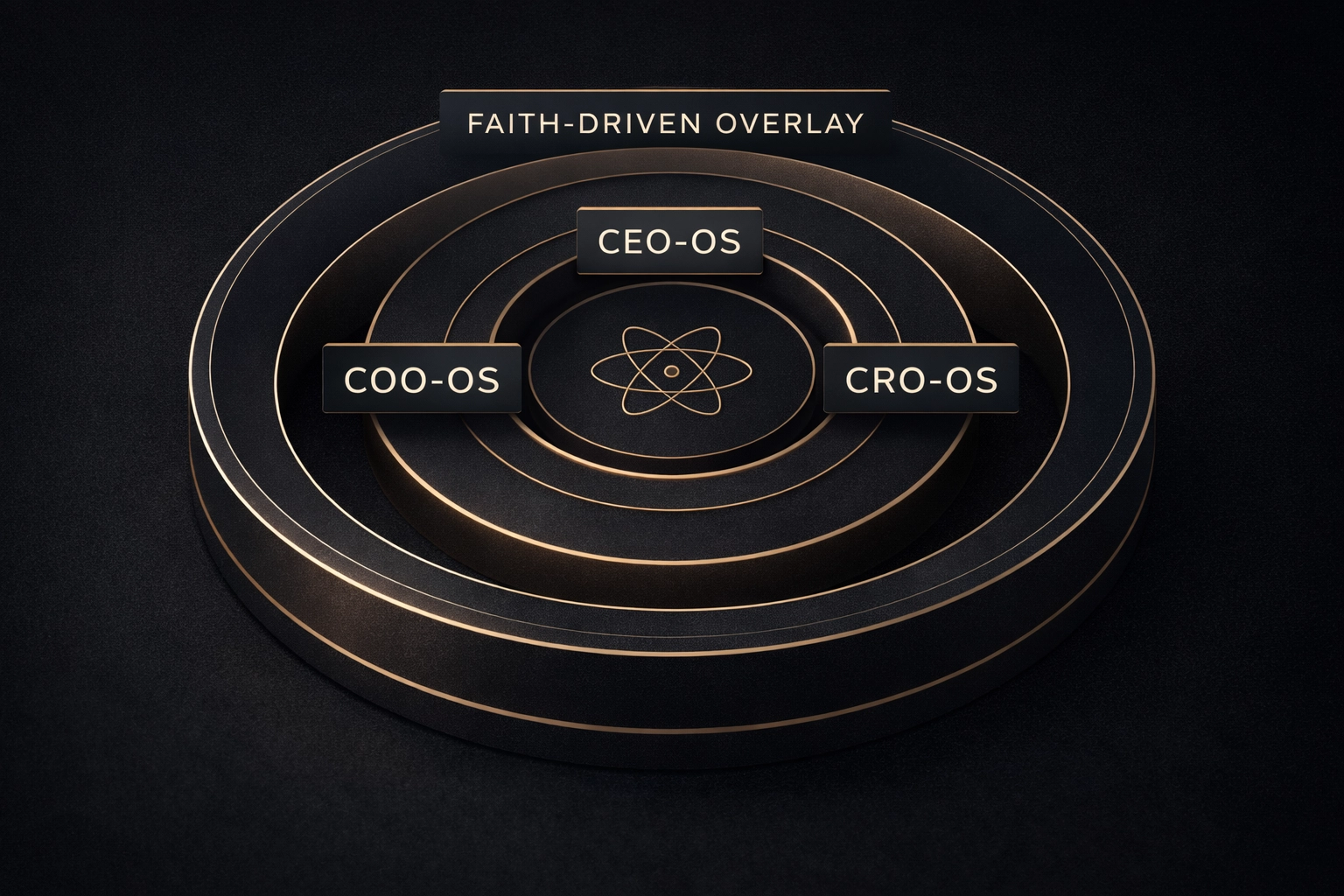
It treats it as a Faith-Driven Overlay—a specialized set of coaching modules and leadership instructions that snaps onto the standard CEO-OS, COO-OS, and CRO-OS.
Not a replacement.
An enhancement—adding spiritual integrity without sacrificing world-class operational discipline.
This post is for C-suite leaders running $5M–$100M+ organizations who want to lead with spiritual integrity—without turning their company into a Sunday sermon or a compliance risk.
You keep the standard architecture.
You add the faithful layer.
You don't need more inspiration. You need Stewardship Infrastructure.

The Problem: Compartmentalized Leadership (Sunday vs. Monday)
Here's the pattern.
You believe in servant leadership, but your org chart looks like a command-and-control hierarchy. You value integrity, but your sales comp plan incentivizes corner-cutting. You talk about stewardship, but your decision-making is reactive chaos held together by your personal heroics.
That is not stewardship.
That is a shepherd with no staff—and no fences.
The disconnect isn't intentional. It's structural.
Most leaders treat faith as a motivational moment—something personal that never gets translated into leadership mechanics. So Monday shows up. Pressure shows up. And your convictions get pushed to the margins.
The fix is not turning faith into the whole operating system.
The fix is installing a Faith-Driven Overlay—clear modules, clear instructions, and clear language that attaches to the standard CXO-OS architecture.
That's the gap the Faithful Stack closes.
This is the Shepherd-as-CEO model.
Your standard CEO Operating System™, COO-OS, and CRO-OS stay intact—disciplined, measurable, and execution-first.
Then the Faithful Add-on snaps on top.
It turns a great operating system into a faithful one—by adding stewardship language, servant-leadership constraints, and spiritually grounded leadership instructions without weakening operational standards.
CEO-OS: Identity-Driven Decision DNA
The CEO-OS isn't about what you believe. It's about how you make decisions at scale.
The Faith-Driven Overlay ensures those decisions carry spiritual integrity—without breaking the discipline of the standard system.
Most CEOs lead from intuition. Faith-driven CEOs want to lead from conviction: but without a systemized framework, conviction becomes inconsistency. You make one call based on generosity, another based on margin pressure, and your team never knows which version of you they're getting.
CEO-OS solves this by encoding your Identity-Driven Decision DNA.
This means:
Your core values aren't aspirational posters. They're decision filters embedded in every strategic choice.
Your "red lines" (ethical, strategic, cultural) are documented and non-negotiable: so you stop relitigating them in every high-pressure moment.
Your "never again" lessons become institutional memory, not personal trauma you carry alone.
Example: A faith-driven CEO defines a red line: "We do not grow by deception, even if it's legal." That principle doesn't live in your head. It becomes a documented instruction inside the Faith-Driven Overlay—then it gets enforced through the standard CEO Operating System™ decision filters, review cadences, and messaging frameworks. The marketing team doesn't need to guess. The architecture carries it.
This is not faith replacing operational discipline.
This is faith enhancing it.
Your team doesn't execute “religion.” They execute documented leadership instructions—clear, consistent, and aligned—so you stop code-switching between Sunday conviction and Monday execution.
COO-OS: Scaling Grace & Accountability (Culture as Infrastructure)
Culture isn't what you say in all-hands meetings. Culture is what your systems reward and punish.
Most faith-driven leaders want a culture of grace: but they built an org structure that runs on fear. Performance reviews are vague. Feedback loops are broken. Accountability is inconsistent. So "grace" becomes cover for mediocrity, and "accountability" becomes reactive rage when something breaks.
COO-OS treats culture as executable infrastructure, not vibes.
Here's what that looks like:
Rituals that embed values into daily operations: weekly peer feedback loops, monthly celebration of "stewardship wins," quarterly values audits.
Scorecards that measure both outcomes and behaviors aligned with your principles (e.g., "Revenue growth" + "Customer advocacy actions").
Escalation paths that ensure hard conversations happen with clarity and compassion: not avoidance or blowups.
Grace without structure is chaos. Accountability without grace is cruelty. COO-OS gives you both.
A practical example: One client's COO-OS included a "Hard Conversations SLA": if a manager had concerns about an employee, they had 7 days to initiate a documented coaching session. No ghosting. No passive-aggression. The system enforced relational integrity as an operational standard.
That's not "soft leadership." That's scaling grace as a competitive advantage.
CRO-OS: Ethical Predictability (Revenue without the Sleaze)
Most revenue teams operate in moral gray zones.
The pitch deck oversells. The demo hides limitations. The sales comp plan rewards whatever closes, regardless of fit. Then leadership prays for "wisdom" while wondering why churn is spiking and Glassdoor reviews are brutal.
The problem isn't bad people. It's bad systems.
CRO-OS builds ethical predictability into your revenue engine: so your team doesn't have to choose between their quota and their conscience.
Here's how:
ICP filters that disqualify prospects who aren't a fit, even if they have budget. (Stewardship > short-term ARR.)
Sales messaging frameworks rooted in truth-telling, not manipulation. No bait-and-switch. No "fake urgency." No feature promises the product team hasn't built yet.
Compensation structures that reward long-term customer success, not just closed-won velocity.
One CEO installed a rule in their CRO-OS: "If we wouldn't recommend this to our mother, we don't sell it to a prospect." That single principle cascaded into demo scripts, pricing transparency, and a refund policy that became a differentiator in their market.
Revenue doesn't require compromise. It requires a system that makes ethics the default, not the exception.
The Legal Shield: How Structure Protects Your Faith and Your Team
Let's talk about the part most faith-driven leaders avoid: legal exposure.
You want to lead with your values. You're also terrified of lawsuits, EEOC complaints, and liability. So you stay vague, avoid explicit faith language, and hope no one sues you for having a Bible study in the break room.
Here's what most leaders miss: Structure is your legal shield.
Title VII of the Civil Rights Act protects religious expression: but only when it doesn't create "undue hardship" for the business or employees. The landmark Groff v. DeJoy case (2023) clarified that "undue hardship" means substantial increased costs or operational disruption: not minor inconvenience or hypothetical discomfort.
Translation: If your faith-driven leadership is systemized, documented, and operationally neutral, you stay on solid ground. If it's ad-hoc, inconsistent, or coercive, you create unnecessary risk.
The Faithful Add-on exists to keep this clean—faithful in content, disciplined in structure, and defensible in execution.
The CXO Operating System gives you that structure.
When your values are carried through a documented Faith-Driven Overlay, then enforced through the standard CEO-OS decision filters (not mandates), the COO-OS behavior systems (not forced participation), and the CRO-OS process standards (not personal preferences), you've created a defensible framework.
Faith stays explicit.
Operations stay world-class.
You're not imposing religion. You're operating from a documented leadership philosophy that happens to be rooted in faith. Employees can disagree with your worldview and still execute within your operating system. That's the legal line.
A documented OS also protects your team. When expectations are clear, escalation paths are defined, and decision rights are mapped, no one is left guessing what "faith-driven leadership" means in practice. Ambiguity creates lawsuits. Clarity creates trust.

The Outcome: Moving from Heroic Bottleneck to Faithful Steward
Most faith-driven CEOs are exhausted.
You're the only one who "gets it." Every decision routes through you because you're the only one who can interpret the company's values in real time. You're not leading. You're translating.
That's not stewardship.
That's a shepherd sleeping in the gate because there are no fences.
The Faithful Stack changes the equation.
It installs Stewardship Infrastructure—the staff and fences your organization needs to stay safe, aligned, and productive without you standing watch 24/7.
And it adds the Faithful Add-on—a Faith-Driven Overlay that snaps onto the standard CEO-OS, COO-OS, and CRO-OS so your leadership stays spiritually intact and operationally excellent.
When the overlay is installed and the operating systems are running, your organization executes faithfully—without you in every room.
Your values don't require your constant presence. They're embedded in the operating system.
Your team doesn't need to guess what you'd do. The system tells them.
You move from heroic bottleneck to faithful steward: leading by design, not by desperation.
This is what it looks like when kingdom values stop being a Sunday thing and start being a Monday–Friday competitive advantage.
Ready to stop compartmentalizing?
The CXO Operating System installs your faith as infrastructure: not inspiration. If you're leading a $5M–$100M+ organization and want to build a company that operates on conviction, not chaos, let's talk.
Visit CXO-OS to see how we architect leadership systems that scale.
Decide with Precision. Lead with Impact.


